
 Back to all news
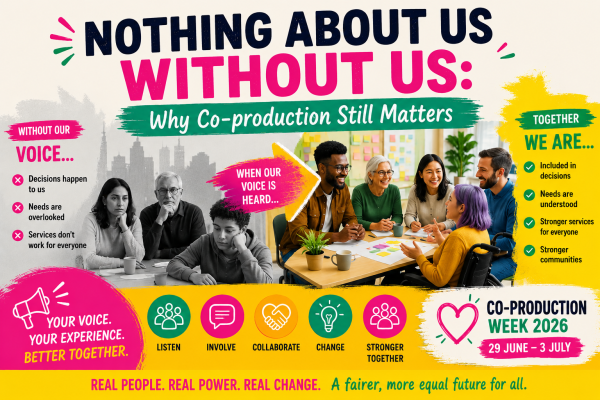
Nothing About Us Without Us: Why Co-production Still Matters
Co-production Week 2026: 29 June – 3 July 2026
What happens when the people who use services help design them?
What happens when lived experience sits alongside professional expertise?
What happens when communities are involved not just in consultation, but in decision-making?
The answer is often better services, stronger relationships and outcomes that genuinely reflect people's needs.
That's why the Social Care Institute for Excellence (SCIE) is once again championing Co-production Week, taking place from 29 June to 3 July 2026.
This annual campaign celebrates the power of co-production and encourages organisations, communities and individuals to reflect on how they involve people in shaping services, systems and decisions.
This Year's Theme: Care Equity – Who Gets Care?
This year's theme, "Care Equity: Who Gets Care?", explores an important question.
Do all people have equal access to the care and support they need?
The theme follows the launch of SCIE's new Care Equity Evidence Hub and focuses on understanding the barriers that can prevent people from accessing high-quality social care, particularly those from marginalised or underrepresented communities.
It asks us to consider:
- Who is included in decisions about care?
- Who is missing from the conversation?
- Whose voices are heard?
- Whose voices are overlooked?
- How can services become more equitable and inclusive?
These are questions that resonate far beyond social care and are relevant across the voluntary, community and social enterprise sector.
Why Co-production Matters
Many organisations already recognise the value of involving people with lived experience in their work.
However, co-production is more than consultation.
It is more than asking people for feedback once a project has been designed.
True co-production means working together from the start. It means sharing power, listening to different perspectives and recognising that lived experience is a form of expertise in its own right.
For the VCSE sector, co-production can help:
- Design services that better meet community needs
- Build trust and stronger relationships
- Improve accessibility and inclusion
- Increase engagement and participation
- Create more sustainable and effective solutions
- Strengthen funding applications and evidence of impact
When people are involved in shaping services, they are often more likely to engage with them.
The VCSE Sector Has Much to Share
Across Hull, East Yorkshire and beyond, co-production is already happening in many forms.
Community organisations are working alongside residents to design local services.
People with lived experience are helping shape homelessness responses, mental health support, youth provision, disability services and community development programmes.
Volunteer-led groups are identifying local priorities and influencing decisions.
Community researchers are gathering insight and informing service improvement.
Young people are helping shape the future of youth services.
While we may not always label it as co-production, much of the sector's work is built on the principle that communities should be involved in decisions that affect them.
Co-production Week provides an opportunity to celebrate these achievements and share learning with others.
How Can You Get Involved?
Share Your Stories
What examples of co-production are happening within your organisation?
Who has helped shape your services?
What have you learned?
Sharing examples can inspire others and demonstrate the value of working in partnership with communities.
Reflect on Your Practice
Co-production is a journey rather than a destination.
The week provides an opportunity to ask:
- Are we involving the right people?
- Are some voices missing?
- How much influence do communities really have?
Start Conversations
Sometimes the most important step is simply beginning the discussion.
Talk to your staff, volunteers, trustees, partners and service users about what meaningful involvement looks like and how it could be strengthened.
Co-production and Community Development Go Hand in Hand
At its heart, community development is built on many of the same principles as co-production.
It recognises that communities hold valuable knowledge, skills and expertise.
It values lived experience.
It seeks to shift power closer to people.
And it believes that lasting change happens with communities, not to them.
As the sector continues to tackle complex challenges, from health inequalities and social isolation to poverty and access to services, co-production will remain a vital tool for creating solutions that are effective, inclusive and sustainable.